杨永斌:《不等支承刚度条件下桥梁-车辆动力耦合解析理论及应用》
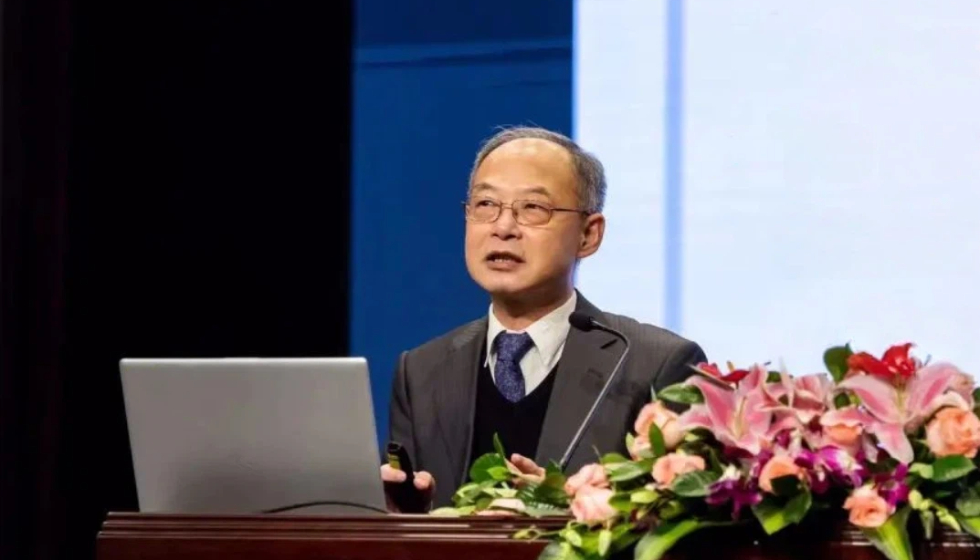
作者:杨永斌(中国工程院院士,教授,重庆大学工程振动与防灾研究中心主任)
 由于支座、桥墩地基等的作用,桥梁端部实际受弹性支承约束,且因施工误差、材料老化等影响,两端支承刚度常常不等。为揭示支承、梁体、车辆之间的耦合关系及不等支承条件的影响,建立了不等支承刚度条件下桥梁-车辆动力耦合解析理论。首先,基于振型叠加法推导了考虑不等支承刚度约束的桥梁、车辆动力响应闭合解,解析了弹性支承条件对车-桥系统响应的时频影响关系;其次,建立了弹性支承条件下车-桥耦合有限元模型,验证了解析理论的准确性;然后,研究了弹性支承刚度及左、右不等程度对车-桥系统响应的放大效应;最后,探索了基于车辆响应的桥梁频率及支承刚度状态的间接测量方法。研究结果表明:1、支承刚度衰减使桥梁频率降低,响应幅值增大,且频率阶次越高影响越显著;2、车-桥系统响应幅值与车辆起始运行位置的桥端支承刚度成反比,从刚度弱侧支承端出发的车辆响应被显著放大,即“弱侧放大”现象;3、车体响应中包含桥梁频率,且呈现左右对称分叉特征,证实了利用车体加速度响应识别弹性支承梁频率的可行性;4、利用车辆正反双向行驶加速度响应的“弱侧放大”现象,可判别桥梁支承的弱刚度端,同时增强桥梁频率的辨识,且对路面平整度、结构阻尼、噪声、伴随车等实测干扰因素具有较高的鲁棒性。
Due to the effect of elastic support, pier foundation and so on, the bridge end is actually constrained by elastic supports, while owing to the influence of construction error, material aging and so on, the two ends of the support stiffnesses are often unequal. In order to reveal the coupling mechanism between elastic supports, bridge and vehicle, as well as the influence of unequal elastic supports, the analytical theory of vehicle-bridge interaction (VBI) considering unequal support stiffnesses is established in this paper. Firstly, based on the mode superposition method, the closed-form solutions are derived for the dynamic responses of bridge and vehicle, and the influence mechanism of the elastic support conditions on the response and characteristic frequency of vehicle-bridge system is unveiled. Secondly, the finite element model of the VBI system considering elastic supports is established to verify the accuracy of the proposed analytical theory. Then, the amplification effect of elastic support stiffnesses and the inequality ratio on dynamic response of vehicle-bridge system is studied. Finally, the feasibility of using the vehicle dynamic response to indirectly measure the bridge frequencies and detect the state of support stiffnesses is investigated, along with the parametric study against vehicle speed, road roughness, structural damping, etc. The results show that:① the decrease of bridge end support stiffness will reduce the bridge modal frequencies but increase their amplitudes, while the higher orders the more obvious phenomenon. ② The amplitudes of vehicle-bridge dynamic response are inversely proportional to the bridge end support stiffness whence the vehicle starts to move. The response of the vehicle will be made much larger when moving from the end with a softer bearing. ③ Bridge frequencies are clearly contained in the vehicle response, while appearing as the left and right symmetric bifurcation feature due to vehicle motion, this confirms the feasibility of using the vehicle acceleration response to indirectly identify the modal frequencies of elastically support beams. ④ By using the round-trip vehicle acceleration responses, the weak-end and high-mode frequencies of bridges can be well detected even under the effect of field factors including structural damping, road surface roughness, environmental noise, accompanying vehicle, etc.
作者介绍:
杨永斌:结构力学与动力专家,中国工程院院士,奥地利科学院外籍院士、欧盟科学院院士、欧洲科学与艺术院院士,台湾大学名誉教授,重庆大学工程振动与防灾研究中心主任、重庆大学土木工程学院荣誉院长,美国土木工程师学会会士、国际计算力学学会会士、台湾力学学会会士。曾担任台湾大学工学院院长、云林科技大学校长;2014年全职加盟重庆大学。杨永斌院士长期从事结构力学与动力研究,研究领域包括:结构非线性理论、桥梁动力理论、和列车波动传播分析法。出版英文专著4部,在中国国内外期刊发表学术论文230余篇、中国国内外会议论文270余篇,2016年成为全球150位土木工程高被引学者。曾获国际华人计算力学奖、TsuboiAward、NishinoMedal、Zienkiewicz Medal、国科会杰出研究奖(台湾)、美国土木工程学会(ASCE)大中华区终身成就奖、IASS荣誉会员、重庆市杰出英才奖、李国豪原创桥梁技术奖、重庆市自然科学一等奖、中国公路学会科学技术特等奖等。
邀请老师演讲、授课请致电:19821197419 阎老师[微信同号]
免责声明:以上内容(包括文字、图片、视频)为用户上传并发布,本平台仅提供信息存储服务。如涉及版权问题,请联系我们并提供版权证明,我们将立即删除!